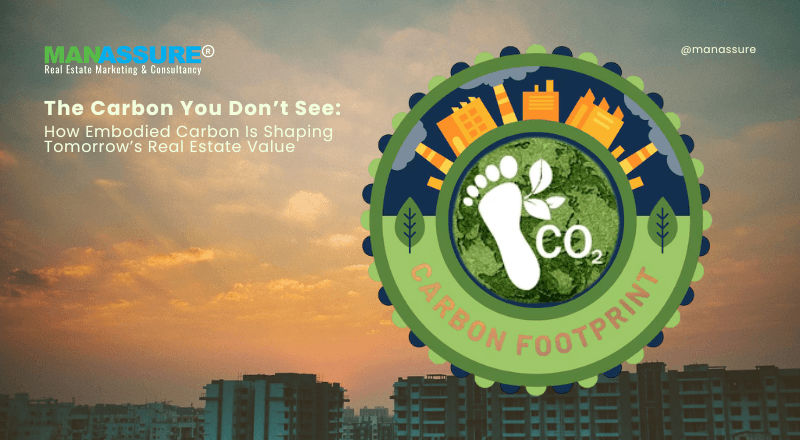
Most people think about carbon emissions as something that happens once a building is operational— lights turned on, air conditioners running, elevators moving. But the largest share of a building’s total carbon impact is already locked in before anyone moves in. This hidden footprint is known as embodied carbon.
Embodied carbon is the total greenhouse gas released during the extraction, production, transportation, and installation of building materials. Unlike operational carbon, which can be reduced over time, embodied carbon is permanent. Once emitted, it can’t be reversed.
Why Embodied Carbon Matters Now
Buildings are responsible for a significant share of global emissions, and embodied carbon makes up a large portion of it. As cities grow and construction accelerates, this invisible footprint is becoming a central factor in how projects are financed, regulated, and valued.
A project may look modern and efficient on paper, but if its embodied carbon is high, it carries a long-term environmental cost that can affect its marketability, financing, and compliance.
For developers, ignoring embodied carbon is no longer an option. For investors, it’s a signal of risk. For communities, it’s a question of environmental impact.
Where Embodied Carbon Comes From
Embodied carbon is built into a project long before operations begin. Key sources include:
Extraction and processing of raw materials like cement, steel, glass, and aluminum
Manufacturing of components such as concrete blocks, panels, tiles, and insulation
Transportation of these materials to the construction site
Construction activities and energy use during assembly
Every stage adds to the total carbon footprint, and by the time the building is completed, most of its lifetime emissions have already been released into the atmosphere.
The Regulatory and Market Shift
Governments and financial institutions are tightening carbon reporting requirements. Green certifications are no longer optional for large-scale projects. Embodied carbon is now part of many ESG reporting frameworks, and upcoming net-zero targets will put even more pressure on builders to reduce this hidden footprint.
This shift also affects financing. Banks and institutional investors are starting to favor low-carbon developments because they carry lower long-term compliance risks. Buyers are more aware and look for projects that reflect responsible development.
A project with a low embodied carbon footprint is not only better for the planet—it is also more attractive in the market.
How to Reduce Embodied Carbon
Reducing embodied carbon begins with intentional planning and design. Some of the most effective strategies include:
Material choices: Prioritizing low-carbon materials like fly ash concrete, recycled steel, bamboo composites, and locally sourced stone.
Efficient design: Using passive design principles, optimizing building form, and reducing material quantities without compromising strength or quality.
Digital modeling: Leveraging BIM and digital twin technology to track carbon impact during design and construction.
Vendor ecosystem alignment: Choosing suppliers and contractors that follow sustainable practices and verified sourcing standards.
Modular and adaptive structures: Designing for longer lifecycles and easier reuse, which reduces future carbon impact.
The Economic Value of Low-Carbon Buildings
Reducing embodied carbon is not just good practice. It builds value.
Stronger financing prospects: ESG-aligned projects attract green finance, bonds, and favorable lending terms.
Better long-term performance: Low-carbon materials often lead to lower operational costs and better durability.
Market differentiation: Buyers and tenants are more likely to trust and invest in a project with clear sustainability metrics.
Regulatory readiness: Future compliance becomes easier, reducing delays and unexpected costs.
In short, low-carbon projects age better and perform better.
Why Early Action Matters
Embodied carbon cannot be “fixed later.” Once the structure is built, those emissions are locked in for decades. Early intervention is the only way to avoid carrying that burden forward. Projects that address embodied carbon from the first drawing board create lasting advantages.
This is where many developers miss an opportunity. By the time ESG is considered, material choices have already been made and most of the carbon impact has occurred. Starting earlier changes everything.
Manassure’s Carbon Intelligence Approach
Manassure builds carbon intelligence into the foundation of every project. This means:
Mapping the carbon footprint of materials before procurement
Working with sustainable vendors and verified supply chains
Using digital tools to model and monitor carbon impact
Aligning construction timelines with ESG targets
Designing structures with long lifecycles and adaptive use
This approach doesn’t just reduce emissions. It creates assets that meet market expectations, regulatory demands, and environmental responsibility.
For Developers and Investors
Reducing embodied carbon is no longer about keeping up with regulations. It’s a strategic decision that shapes the financial and environmental strength of an asset. Projects that carry a low carbon footprint are easier to finance, easier to market, and better positioned for long-term performance.
For developers, this is a pathway to stronger project differentiation.
For investors, it’s a way to protect value.
For communities, it’s a step toward shared environmental responsibility.
Building for the Future
Embodied carbon may be invisible, but its impact is real. It defines how buildings age, how they’re valued, and how they shape the world around them. Developers and investors who act early will not only meet future requirements but lead the market.
The future of real estate is not only about what we build—it’s about what we leave behind.
To build low-carbon, high-value projects with measurable ESG impact, visit www.manassure.in or write to contact@manassure.in.
Share this Post:

Related Reads for You




By Manas, Green Projects Consultancy, Hyderabad Real Estate, Marketing Management, Project Management, Real Estate Advisory, Real Estate Technology, Transforming Intelligence